
Named Engineers. Real SLOs.
AWS and Azure migrations, Kubernetes platforms, CI/CD, SRE, and DevSecOps under governance. Five doors into the practice, migration, Kubernetes, CI/CD, reliability, and security, plus embedded AWS, Azure, and DevOps engineers when a hire is the right shape.
250+
Engineers across AI
2000+
Projects Delivered
30%
Cloud-cost reduction
92%
Client Retention
12+
Countries Catered




2k+
Completed Projects

We’re an engineering team that treats reliability as a design decision, not a hope. We’re built from engineers who’ve owned an on-call rotation, not just configured one, and know the difference between a migration that ships and one that quietly becomes a program with no end date. That’s why every engagement runs under the same governance model, clear ownership, defined SLOs, and an exit plan from day one. That’s the kind of team we are, whether the engagement is a single pipeline fix or a full platform build, and it’s why we at RCV World treat cloud and DevOps work as a reliability problem first.






Cloud migration, Kubernetes consulting, CI/CD pipeline services, site reliability engineering, DevSecOps
Engineering leaders whose deployments are slow, unreliable, or heavily dependent on manual processes
Fixed-scope build, dedicated team, or embedded engineers, see the comparison below
2 to 4 weeks from scoping call to first sprint
Starting price signal: Scoped estimate before contract, start with the cost calculator
Our engineering expertise spans the platforms, frameworks, and
protocols enterprises are actually standardizing on right now.
We build with the same models and protocols now standard in production agentic AI, not last year’s chatbot stack. Multi-agent orchestration and governance are part of the build, not an afterthought.
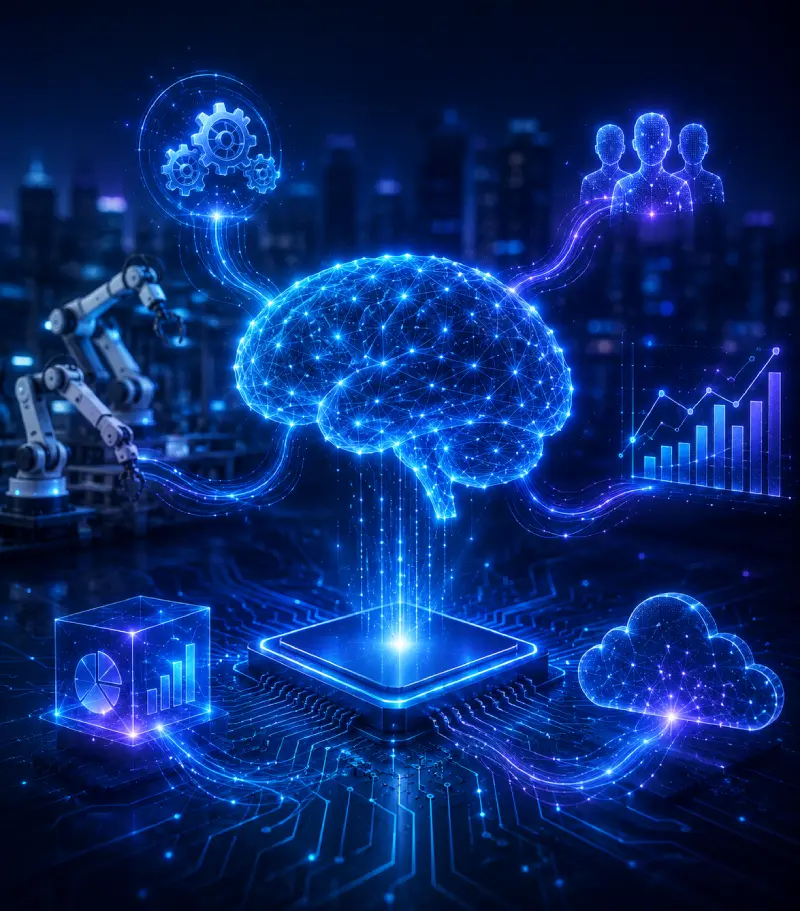
AI writes a growing share of the code today. Our engineers still own the architecture it lands in, the part that decides whether a system holds up in year three, not just at launch.
Platform engineering and FinOps discipline keep releases moving fast and the cloud bill explainable, tied to what’s actually driving cost, not a surprise at month’s end.

Manual data cleanup is disappearing into automation. What’s left, lineage, governance, and integration your team can actually audit, is where we put senior engineers.
Predictive monitoring catches most incidents before an alert fires. When one does reach a person, it’s already been triaged, not sitting in a queue.
Every vendor promises faster deployments, scalable infrastructure, and cloud transformation. Most engagements stop at migration or leave teams with infrastructure they struggle to operate. The real gap is the engineering discipline between infrastructure that runs and systems a business can depend on: automated CI/CD, resilient Kubernetes platforms, security built into delivery, and observability that catches issues before customers do. That’s the work we do, as a Cloud & DevOps services company built around reliable production, not migration checklists.

Most Cloud & DevOps services engagements enter through one of five doors. The right door depends on what’s actually broken, the platform, the pipeline, the reliability model, or the security posture, and the diagnostic is the first thing we do.
AWS and Azure migrations sequenced to ship, not to drift. Lift-and-shift where the ROI is real, re-architecture where the workload demands it, and multi-cloud consolidation for organizations paying twice for the same capability, all with a documented cutover plan and a rollback path that's been tested.
Cluster migration, cost optimization, and multi-tenant platform builds, from the first EKS or AKS deployment through the second replatforming, when the initial architecture no longer fits the workload it's running.
Pipeline modernization, deployment-frequency improvement, and monorepo or polyrepo tooling, for teams whose CI has become the bottleneck the code review used to be.
On-call and incident-response setup, SLO and error-budget definition, and reliability audits, the difference between an uptime number that reads well in a quarterly review and one an on-call engineer would defend at 3 a.m.
Security controls inside the pipeline rather than around it, SAST, DAST, SBOM generation, dependency scanning, secrets handling, and policy-as-code, so the security team stops being the gate and starts being the design partner.
Every engagement runs on the RCV Delivery Model™ underneath. Which shape it takes for your cloud or DevOps work depends on the problem, not a package we default to.
| Model | Best Fit When | What You Get | Buyer Proof Artifact |
|---|---|---|---|
|
RCV Outcome Delivery Pods |
A specific reliability or delivery metric needs to move, like deployment frequency or MTTR, not just “cloud work” generally |
KPI framing, a product pod, delivery analytics, value reviews, release telemetry |
Product KPI scorecard and release-health dashboard |
|
RCV Platform Accelerator |
A platform capability, like a shared Kubernetes environment or golden-path CI/CD, needs to serve multiple teams, not get rebuilt per project |
Platform diagnostic, foundation sprint, golden paths, onboarding, adoption telemetry |
Platform catalog, adoption metrics, golden-path demo |
|
RCV Governance Assurance Model |
A migration or platform build spans multiple environments, vendors, or a compliance requirement that demands full auditability |
Governance handbook, cadence map, RAID log, quality gates, architecture controls, transition pack |
Real dashboard pack, escalation matrix, sample exit/transfer pack |
Cloud & DevOps services are useful because they solve a scoped problem, embedded engineers are useful because they cover an ongoing capability gap. Choosing between the two shapes is the highest-impact decision on this page. Here’s the rule we actually use, including the row where the honest answer is “don’t hire us for that.”
| A good fit if… | Probably not a fit if… |
|---|---|
|
You need to migrate, modernize, or scale production infrastructure
|
You only need a basic cloud migration with no engineering ownership |
|
Your deployments are slow, unreliable, or heavily dependent on manual processes |
Your infrastructure is stable and you only need occasional operational support |
|
You need engineers who own cloud architecture, CI/CD, security, and observability together |
You only need extra DevOps headcount without ownership of outcomes, see Hire DevOps Developers |
Need cloud and DevOps expertise on your own team instead of a scoped project? We embed senior cloud and DevOps engineers directly into your team, working your backlog under your engineering lead, from infrastructure and automation to deployments and reliability.
Need cloud and DevOps expertise on your own team instead of a scoped project? We embed senior cloud and DevOps engineers directly into your team, working your backlog under your engineering lead, from infrastructure and automation to deployments and reliability.

We map your current AWS or Azure footprint and flag every manual step in your deployment pipeline.

We choose the migration pattern, lift-and-shift or re-architecture, and lock the team against your stack.

We migrate in waves with a tested rollback path, shipping through canary or blue-green releases.

SLOs, error budgets, and a live risk register run on the same dashboard your on-call engineer uses.
We hand over Terraform, runbooks, and on-call training, then support the first live incident before stepping back.

We build and run infrastructure tuned to the regulations, uptime expectations, and realities of your industry.
Straight answers to what enterprise and fast-scaling buyers ask most.
Yes, cost is treated as a first-class outcome of Cloud & DevOps services, not a side-effect measured at month-end. That means right-sizing during migration rather than after it, reserved-capacity and savings-plan decisions made against your actual usage curves, and cost dashboards wired into the same observability stack as reliability metrics. For steady-state cost management, we run FinOps engagements with defined baselines and monthly reviews. Where a workload is genuinely uneconomic in cloud, and some are, we'll say so.
Yes, and it's one of the more common engagement shapes. The takeover follows a defined pattern: a two-week deep read of the existing pipelines, infrastructure, and documentation, a written diagnostic naming what's working, what's at risk, and what's broken, then a scoped remediation and hand-forward plan. Some pipelines are salvageable with targeted rework; some are cheaper to rebuild than to preserve, and we'll say which is which. We won't pretend a rewrite is a takeover to secure a bigger scope.
Both, in the sense that most engagements combine advisory and execution, and neither, in the sense that pure advisory rarely ships change. As a DevOps consulting company, we deliver assessments, Kubernetes reviews, SRE audits, DevSecOps posture, cloud cost audits, reference architectures, and target-state designs. As a build shop, we deliver the migrations, platforms, pipelines, and automation itself. If you need only the advisory piece, we'll scope it that way.
Yes. Certified engineers on all three, and we pick the platform based on your workload, latency needs, and existing footprint, not a default we push you toward.
Help. Cloud & DevOps services from RCV World are designed to leave your team in a stronger position, not create a dependency. Every engagement includes explicit knowledge-transfer artifacts, runbooks, architecture decision records, on-call training, pairing with your engineers throughout delivery, and a Transition & Scale phase whose success criterion is that your team can run the outcome without us. The measure of a good engagement isn't how long it lasts, it's what your team can do afterward that they couldn't do before.
You do. Work delivered under an RCV World engagement is work for hire: source code, Terraform and Helm charts, pipeline configurations, runbooks, and documentation transfer to you, and Transition & Scale exists specifically to make that ownership operational. Cloud accounts and Kubernetes clusters remain under your ownership at all times. There's no lock-in mechanism by design, a platform you can't leave is a liability.
Zero downtime is achievable for most workloads, but it depends on the architecture, not just the migration plan. Stateless services can usually cut over with a blue-green swap and no visible interruption. Stateful systems, databases especially, need a replication and cutover window planned around your actual traffic pattern, sometimes seconds, sometimes a scheduled maintenance window we agree with you in advance. We test the rollback path before cutover, so if something doesn't hold, reverting is a known procedure.
Hybrid, on-prem-plus-cloud, and cloud-only are all in scope. A lot of what we're brought in for is exactly the messy middle, workloads that can't move yet for compliance or latency reasons, sitting alongside services that already have. We design the network, identity, and CI/CD boundary between the two environments explicitly. Some clients stay hybrid indefinitely, and that's a legitimate end state, not a failure to finish migrating.
Cloud & DevOps services are easiest to scope well before a migration commits or a reliability commitment breaks, not during either. If a project is drifting past its cutover date, a pipeline is bottlenecked, or an SLO is one incident away from being renegotiated, a thirty-minute scoping call is worth having. We’ll name what to build, what to hire for, and what to leave alone.
A 30-minute call with an engineer, your platform, your workloads, your team, your constraints. No slideware.
A written diagnosis: what to migrate, what to modernize, what to hire for, what to leave in place, including the honest “don’t build this” calls.
A scoped estimate with a staged plan, so the first release ships a measurable, defensible outcome before you commit to the rest.
RCV World helps businesses turn technology into measurable growth. We deliver AI, digital engineering, cloud, data, enterprise, managed, and talent solutions built around your goals. Our teams combine technical expertise, strategic thinking, and execution to create secure, scalable, and future-ready solutions for businesses across industries.
