
An agent that can only talk is a chatbot. An agent that can act needs engineering: the tools it may call, the permissions it holds, the approval step before anything irreversible, and a log of every decision. RCV World runs AI agent development the way production software is built, starting with one workflow and a measurable outcome rather than broad autonomy nobody can debug.
Engineers across AI
Projects Delivered
Cloud-cost reduction
Client Retention
Countries Catered
Average Staffing Timimg






Completed Projects

AI agent development covers the full build of systems that take action on your behalf rather than only generating text: use-case selection and feasibility, agent architecture and orchestration, tool and API integration, permission and guardrail design, evaluation and testing, human-in-the-loop approval workflows, and the observability that shows what an agent did and why. RCV World works alongside your engineering and operations teams, with a defined interface contract for every system the agent touches, a named technical owner, and release gates your product owner signs. Agents run in your cloud accounts under your licenses, with the model chosen against your accuracy, latency, cost, and data-residency requirements. Scope ranges from a single-pilot workflow to a platform where several agents share tooling, guardrails, and monitoring.






We build with the same models and protocols now standard in production agentic AI, not last year’s chatbot stack. Multi-agent orchestration and governance are part of the build, not an afterthought.
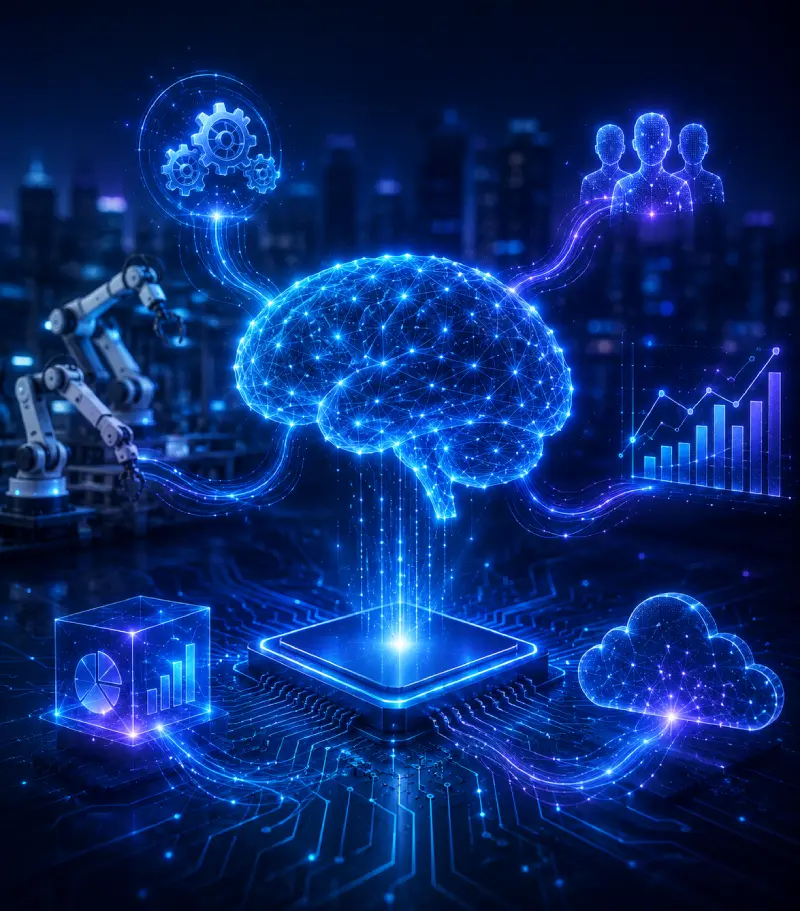
AI writes a growing share of the code today. Our engineers still own the architecture it lands in, the part that decides whether a system holds up in year three, not just at launch.
Platform engineering and FinOps discipline keep releases moving fast and the cloud bill explainable, tied to what’s actually driving cost, not a surprise at month’s end.

Manual data cleanup is disappearing into automation. What’s left, lineage, governance, and integration your team can actually audit, is where we put senior engineers.

Predictive monitoring catches most incidents before an alert fires. When one does reach a person, it’s already been triaged, not sitting in a queue.

Seven build areas of AI agent development that turn a prototype into something you can run in production.
AI agent development starts here: a review of candidate workflows against the things that decide whether an agent works, API availability on the systems involved, whether the decision rules can be written down, volume, and the cost of a wrong action. The output ranks the candidates and identifies those for which a scripted automation would be cheaper and easier to audit.
The reasoning loop, memory, state handling, and the decision on whether one agent or several specialized agents suit the workflow. Multi-step tasks are decomposed so each step is testable on its own, and the architecture is recorded in a decision record with the trade-offs named.
The tools an agent may call are built as explicit, typed interfaces against your ERP, CRM, ticketing, and internal APIs, with the agent given access to nothing outside that set. Retries, timeouts, and idempotency handling are built in because an agent that retries a failed action without idempotency will duplicate the action.
This is where most AI agent development actually happens. Permission scoping runs through your identity provider, so an agent holds only the access its workflow needs, input and output validation, spend and rate limits, and a mandatory approval step before any action with financial, legal, or customer-facing consequences. Autonomy widens only after the narrower version has proven itself in production.
An evaluation suite of real cases with known correct outcomes, run against every prompt, model, or tool change before release. Accuracy, task completion, and failure modes are measured and reported numerically rather than as impressions, so a model upgrade is a tested change rather than a leap of faith.
AI agent development ends in production, not a demo. Agents are deployed through the same pipelines as your other production software, with tracing at every step, logging of each decision and action for audit purposes, alerting on failure patterns, and token and inference costs tracked per workflow. Cost per completed task is visible from the first week rather than discovered on an invoice.
Model choice weighed against accuracy on your evaluation cases, latency, cost per task, and where the data can be processed, with the architecture kept portable so a model can be swapped as the market evolves. Where a hosted model cannot meet data-residency rules, self-hosted options are assessed on the same terms

One Disciplined Framework. Every Engagement.
RCV World reviews the candidate workflows, the systems and APIs involved, the decision rules, and the cost of a wrong action before committing to an agent design: the step most vendors skip on the way to a signed order.
Agent scope, tool access, permission boundaries, approval points, evaluation criteria, and release gates get signed off with your product owner before a single story is pulled into a sprint.
Two-week increments with a working agent demonstrated against real cases at the close of each, backed by the evaluation suite, pipelines, and documentation a production agent needs, beyond what a prototype carries.
Governance isn’t a status meeting. It’s executive steering, a live risk register, quality gates, and value tracking against the roadmap on every engagement.
Knowledge transfer, launch hypercare through the first weeks of live use, and a plan for widening autonomy, adding workflows, or handing the agent back in-house, once it is proven in production.
| Model | Best Fit When | What You Get | Buyer Proof Artifact |
|---|---|---|---|
|
RCV Outcome Delivery Pods |
An agent has to prove measurable value, such as tasks completed without escalation or hours returned, not just demo well |
KPI framing, a product pod, delivery analytics, value reviews, and release telemetry |
Product KPI scorecard and release-health dashboard |
|
RCV Platform Accelerator |
Several agents need shared foundations: tool libraries, guardrails, evaluation suites, and monitoring built once and reused |
Platform diagnostic, foundation sprint, golden paths, onboarding, and adoption telemetry |
Platform catalog, adoption metrics, golden-path demo |
|
RCV Governance Assurance Model |
Agents act inside a regulated, audited, or multi-vendor environment where every action must be explainable. |
Governance handbook, cadence map, RAID log, quality gates, architecture controls, transition pack |
Real dashboard pack, escalation matrix, sample exit/transfer pack |
Agent projects rarely stall on the model. They stall on system access, undocumented decision rules, and no one agrees on what the agent is allowed to do on its own.
| A good fit if... | A better RCV World route if… |
|---|---|
|
Work spans several systems, and a person is currently the connective tissue between them |
The process is fully deterministic, and a scripted workflow would be cheaper to run and audit; see AI Automation |
|
The workflow needs judgment on unstructured inputs, not just a fixed sequence of steps |
What you need is content generation or summarization rather than action; see Generative AI Development |
|
You have a business owner who will define the rules and accept the agent’s outputs |
The models are chosen,n, and the need to wire them into existing products; see LLM Integration |
|
You want the agent, its evaluation suite, and its logs to live in your own tenant |
You already know what to build and need engineers who have built agents before; see Hire AI Developers |
RCV World builds AI agents for businesses in sectors where automated actions carry regulatory, financial, or operational weight. AI agents for business earn trust by acting narrowly and logging everything.
Straight answers to what product and engineering leaders ask most.
AI agent development is often confused with both. A chatbot answers. A script follows a fixed sequence. An agent is given a goal, decides which steps to take, calls tools to carry them out, and reports what it did. That autonomy is the point and also the risk, which is why AI agent development is mostly engineering around the model rather than prompting: scoping tool access, setting permissions, validating outputs, and deciding which actions need a human first. Where a process is fully deterministic, a script remains cheaper to run and easier to audit, and RCV World will say so during scoping rather than build an agent anyway. AI Automation covers that work.
In work that is repetitive, rule-bound, and spread across systems, where a person is currently the connective tissue. AI agent development pays off fastest there. Four patterns cover most production use: workflow agents that pick up a trigger, such as an invoice or ticket, and complete or route it; customer-support agents that resolve routine inquiries against real account data and hand over with context; internal operations agents that answer staff questions and perform provisioning or reporting tasks; and research agents that gather and synthesize material for a specialist to review. Autonomous AI agents work less well where systems have no usable APIs or where decision rules have never been written down.
Through boundaries rather than trust. The agent is given a defined set of tools and nothing else; its permissions are scoped through your identity provider to exactly what the workflow needs, and any action with financial, legal, or customer-facing consequences requires human approval before it executes. Outputs are validated against expected formats and ranges; spend and rate limits cap the damage from a leak; and every decision and action is logged so a person can reconstruct what happened. Evaluation cases run before each release. Autonomy is widened only after the narrower version has proven itself in production, never at launch.
Accuracy is measured against an evaluation suite of real cases with known correct outcomes, built during the project and run against every prompt, model, or tool change before release; the evaluation suite is a deliverable, not internal tooling. Reporting covers task completion rate, escalation rate, and the failure modes behind them, as numbers rather than impressions. No agent is correct every time, so the design assumes failure: consequential actions are gated behind approval, errors surface as alerts rather than silent mistakes, and recurring failure patterns become new evaluation cases and new guardrails. That loop, not a model upgrade, is what raises reliability over time.
Model choice is made based on your evaluation cases, latency needs, cost per task, and where your data is permitted to be processed, not on a house preference or a vendor relationship. The architecture keeps the model behind an interface so it can be swapped as the capability and pricing shift, which they do frequently. Where data residency rules out hosted models, self-hosted options are assessed on the same terms. Your evaluation suite makes a later change safe because it shows whether the new model performs on your actual cases before anything reaches production. LLM Integration covers this in more depth.
Cost depends on how many systems the agent integrates with, the state of those APIs, how clearly the decision rules are defined, the evaluation and compliance requirements, and whether a single workflow or multiple workflows are in scope. A single-workflow agent over-documents APIs, making it a smaller build than a multi-agent platform that touches regulated systems with approval chains. A fixed-scope pilot with stable requirements is quoted as a fixed price; a platform that keeps growing is priced as a standing product team in the scoping proposal. Running costs for models and infrastructure are handled by your vendors and modeled separately. The fastest route to a real number is a scoping call.
AI agent development on a single workflow over documented APIs typically reaches production 8 to 12 weeks after the Diagnose phase, with a working version against real cases much earlier in that window. Undocumented systems, approval chains, or regulated data extend it, and the Diagnose output gives you the number before you commit. The sequence is fixed: use-case and feasibility review, agent and guardrail design sign-off, environment and pipeline setup, tool integration, evaluation suite build, then two-week increments demonstrated against real cases. First releases usually run with a human approving every action, and that gate is relaxed only based on evidence.
You do, from the first commit. Code, prompts, tool definitions, and the evaluation suite live in your repositories, and the agent runs in your cloud accounts under your licenses and your model provider contracts. The evaluation suite matters most here: it is the asset that lets any team maintain, retest, and re-platform the agent later. Contracts assign IP on creation, not on final payment. Data processed by the agent remains within the boundaries you set, and ownership is confirmed in writing during the Design & Capability Match before credentials are issued.
Book an AI agent development scoping call with an RCV World engineer, not a salesperson. Bring the workflow you want handled, the systems it touches, and the cost of a wrong action. The call ends with a plain answer on whether an agent fits, whether a simpler automation would do the same job, and what the first pilot would need to prove before autonomy widens.
RCV World helps businesses turn technology into measurable growth. We deliver AI, digital engineering, cloud, data, enterprise, managed, and talent solutions built around your goals. Our teams combine technical expertise, strategic thinking, and execution to create secure, scalable, and future-ready solutions for businesses across industries.
