
IT Staff Augmentation
A credit union with 340,000 members was halfway off its mainframe when two of its three COBOL engineers retired. The migration stalled seven months behind plan, with the mainframe lease up for renewal at year-end. RCV World provided IT staff augmentation that put seven engineers with core banking experience into the credit union’s own team, paired each one with a staff engineer, and finished the migration before the renewal date.
Sector: Financial services, member-owned credit union
Market: US Pacific Northwest | Reporting period: 2 March to 30 September 2026
9 days
First Mainframe Engineer Started
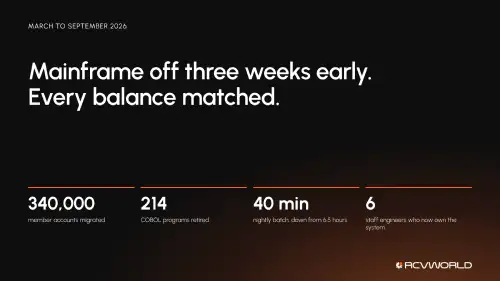
340,000
Member Accounts Migrated
Every balance
Matched at Cutover
6.5 hrs to 40 min
Nightly Batch Window
214
COBOL Programs Retired

When the People Who Knew the Code Retired
Background
The credit union’s core banking system ran on a mainframe: 214 COBOL programs, a nightly batch that took six and a half hours, and business rules that lived mostly in three engineers’ heads. A move to cloud-based Java services had been underway for a year.
Then two of those three engineers retired within a month of each other. The migration slowed to a crawl because nobody left could explain what half the batch jobs actually did. A job posting for a mainframe engineer sat open for nine months. If the work wasn’t done by December, the credit union would have to renew the mainframe lease for another multi-year term.
Hiring wasn’t going to fix this in time, so RCV World set up the engagement around three ideas:
- Bring in people who could read the old code and build the new services, not one or the other
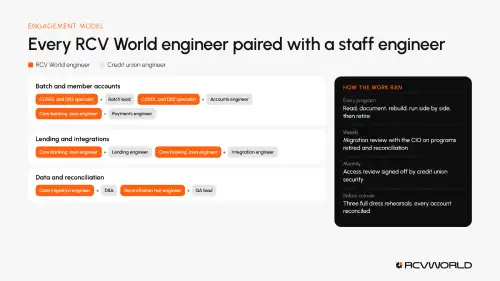
- Pair every RCV World engineer with a credit union engineer, so knowledge stayed in the building
- Prove every migrated account to the cent before switching anything off
The credit union had tried a staff augmentation company before and got résumés. This time it needed engineers who had moved a core banking system before.
Objective
- Get mainframe-skilled engineers working in the codebase within two weeks.
- Document every business rule in the COBOL programs before retiring them.
- Migrate all 340,000 member accounts with zero balance differences at cutover.
- Finish before the mainframe lease renewal date in December.
Our Approach
- Diagnose: Five days with the remaining mainframe engineer and the migration lead, sorting the 214 COBOL programs by risk and by how much undocumented logic each one held.
- Design and Capability Match: Seven engineers from the RCV World bench: two COBOL and DB2 specialists, three Java engineers who had worked on core banking moves, a data migration engineer, and a reconciliation test engineer.
- Mobilize and Deliver: Each RCV World engineer was paired with a credit union engineer, and each COBOL program was read, documented, rebuilt as a Java service, and run side by side with the old version until results matched.
- Govern and Optimize: A weekly migration review with the CIO tracking programs retired, reconciliation results, and pairing hours, with access reviewed every month by the credit union's security team.
- Transition and Scale: Every business rule captured in the credit union's own wiki before its COBOL program was retired, and a contract-to-hire option offered once the mainframe was switched off.

Results and Impact
-
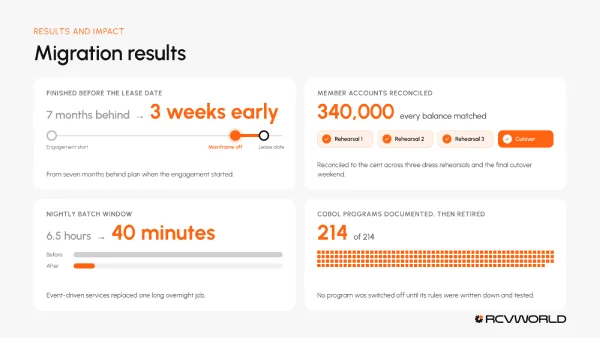
Finished 3 weeks before the lease date:
From seven months behind plan when the engagement started. -
340,000 accounts, every balance matched:
Reconciled to the cent across three dress rehearsals and the final cutover weekend. -
6.5 hours to 40 minutes:
The nightly batch now runs as event-driven services instead of one long overnight job. -
214 programs documented, then retired:
No COBOL program was switched off until its rules were written down and tested.
Rare Skills in Days, Not Months
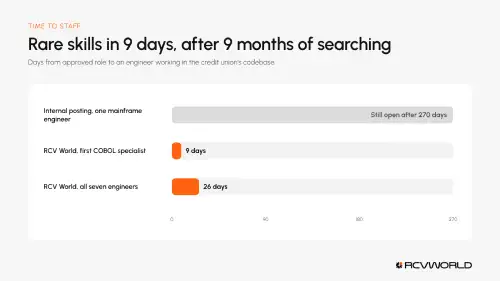
The credit union’s posting for one mainframe engineer had been open for nine months. RCV World matched both COBOL roles from its bench, and the credit union’s CIO ran the final interviews.
- 9 days to the first mainframe engineer: All seven engineers working inside four weeks.
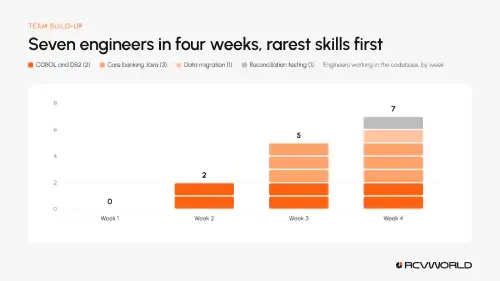
A Team Built in the Order the Code Needed
COBOL specialists came first to read the riskiest batch jobs, then the Java and data engineers who rebuilt and moved them.
- Every engineer paired from day one: With a credit union engineer on every program they touched.
214 Programs Retired, One Rule at a Time
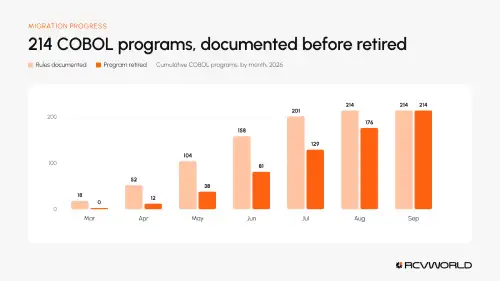
Each program went through the same steps: read it, write down what it does, rebuild it, run old and new side by side, and switch off the old one only when every result matched.
- 0 programs retired without written rules: Every rule now sits in the credit union’s own wiki.
Paired, So the Knowledge Stayed
The real risk was losing what the retired engineers knew a second time. Pairing meant each rebuilt service had a credit union engineer who understood it.
- 1,900 pairing hours logged: Six credit union engineers now own the new services.
Stats Behind the Result
01
7 engineers embedded in 4 weeks
Two COBOL specialists, three core banking Java engineers, one data migration engineer, and one test engineer.
02
3 full dress rehearsals before cutover
Each one reconciled every account before the real weekend.
03
Cutover finished in 31 hours
Inside the planned weekend window, with members back online Monday morning.
04
0 engineers replaced
Every RCV World engineer stayed until the mainframe was switched off.
05
2 engineers joined full-time
Through the contract-to-hire path once the migration closed.
Final Outcome of the Engagement
This wasn't about filling two empty seats.
It was about IT staff augmentation with people who could read 40-year-old code and build its replacement, while teaching the credit union’s own engineers along the way.
The mainframe was switched off three weeks before the lease renewal. Every member balance matched. And six credit union engineers now own the system the retired team used to carry in their heads.
Not a staffing story. A migration story that ended with the mainframe off, every balance matched, and the know-how kept in-house.
Find Out Who Can Read Your Legacy Code
Tell an RCV World delivery lead which systems only one or two people understand. You’ll leave the scoping call knowing which skills the bench can match and how fast those engineers could start.
