
Healthcare Cybersecurity Compliance Across 14 Clinics
A 14-clinic outpatient network partnered with RCV World after a failed risk assessment. RCV World closed the control gaps, locked down remote and vendor access, and built an evidence trail the compliance team can defend, with the governance cadence agreed before any work began.
Sector: Outpatient care, multi-specialty clinics
Market: US Midwest | Reporting period: 6 January to 30 June 2026
94%
HIPAA Control Coverage
87%
Fewer Critical Findings
100%
MFA on Remote Access
72%
Faster Remediation
212
Evidence Artifacts Mapped

The Road to an Audit-Ready Program
Background
The network grew through acquisition. Each clinic arrived with its own firewall, its own vendors, and its own idea of what compliant meant.
A third-party risk assessment in late 2025 returned 46 critical and high findings. Billing vendors reached the network with no multi-factor authentication. Backups had never been restore-tested. Evidence for the HIPAA Security Rule lived in 11 spreadsheets owned by four people.
RCV World took on the work in three moves:
- Access first
- Then detection and recovery
- Building content around the quThen a weekly governance habit to replace the yearly compliance scrambleestions homeowners actually type when they need an electrician
The goal was not a passing score, but a program the internal team could run on its own after handover.
Objective
- Remediate every critical and high finding from the 2025 risk assessment within six months.
- Enforce MFA on all remote, vendor, and privileged access without disrupting clinic schedules.
- Prove recovery by restoring the EHR environment from backup within a set window.
- Map every Security Rule standard to live evidence the compliance officer owns.
Our Approach
- Diagnose: Asset inventory across 14 sites and a map of where patient data moves.
- Design and Capability Match: A cloud security engineer, an identity specialist, and a compliance analyst assigned to the risk register.
- Mobilize and Deliver: MFA rolled out clinic by clinic, medical devices moved onto their own network, backups made immutable.
- Govern and Optimize: Weekly risk review with the CISO, every fix tracked against an agreed deadline.
- Transition and Scale: Runbooks, the evidence library, and training handed to the internal IT team.

Results and Impact
-
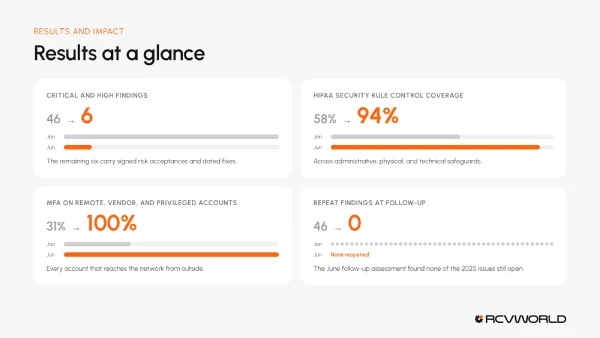
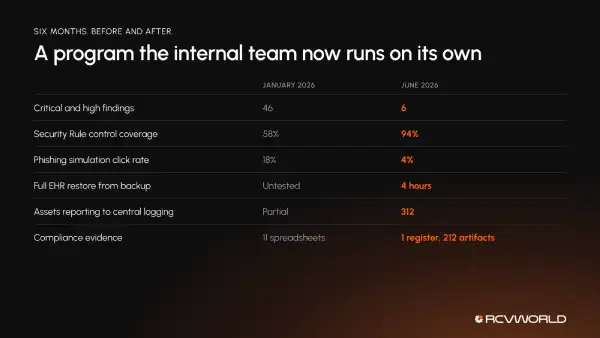
46 to 6 critical and high findings:
The remaining six carry signed risk acceptances and dated fixes -
94% control coverage:
Up from 58% across administrative, physical, and technical safeguards. -
100% MFA coverage:
On remote, vendor, and privileged accounts, up from 31%. -
Zero repeat findings:
The June follow-up assessment found none of the 2025 issues still open.
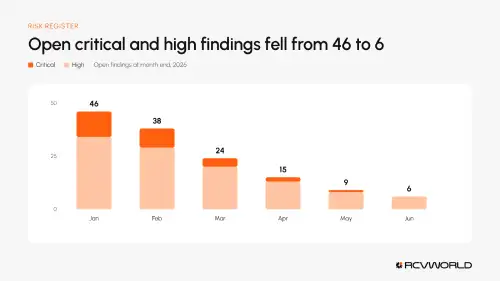
Critical Findings Fell Every Month
Each monthly review closed the highest-severity items first. Every critical finding tied to patient-data exposure or remote access was cleared by May.
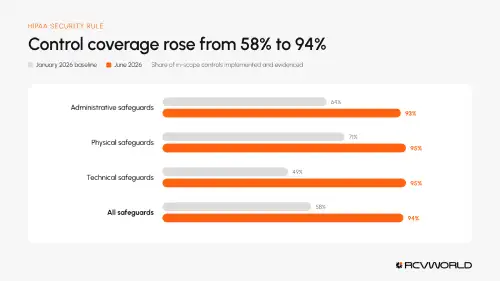
Control Coverage by Safeguard
Technical safeguards moved furthest, once access control, audit logging, and encryption at rest were in place across all 14 sites.
- 49% to 95% technical safeguard coverage: The biggest jump of the three safeguard groups.
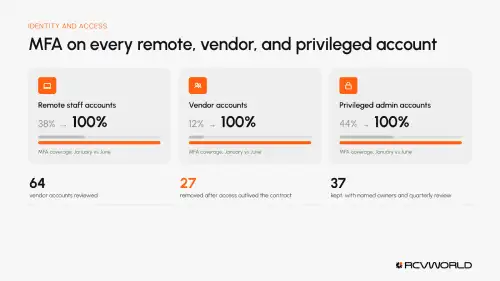
Access Closed at the Front Door
Vendor access was the widest open door, so it was reviewed account by account in the first month.
- 27 of 64 vendor accounts removed: Their access had outlived the contract. The 37 that stayed now have named owners and a quarterly review.
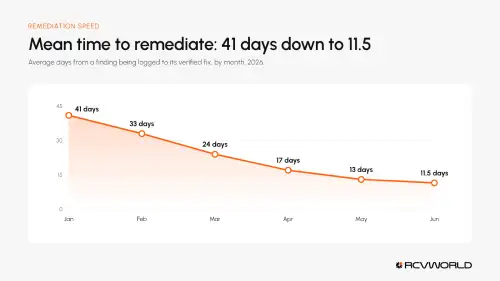
Remediation Measured Every Week
Findings moved out of scattered spreadsheets into one tracked register, each with a named owner and a deadline.
- 41 days to 11.5 days mean time to remediate: 72% faster from finding to verified fix.
Stats Behind the Result
01
312 assets under central logging
Every server, workstation, and network device across 14 sites now reports to one monitoring platform.
02
140 medical devices segmented
Connected clinical devices now sit on their own network, away from staff workstations.
03
Phishing click rate from 18% to 4%
Across three simulation rounds with roughly 1,800 staff.
04
4-hour full EHR restore
Proven from immutable backups in a timed test. Recovery had never been tested before.
05
212 evidence artifacts mapped
Each tied to a Security Rule standard and an owner, in one register instead of 11 spreadsheets.
Final Outcome of the Engagement
This wasn't about passing an assessment.
It was about giving a growing clinic network healthcare cybersecurity compliance that holds up on an ordinary Tuesday, not only in the week before an audit.
The compliance officer now opens one register instead of 11 spreadsheets. The IT team runs the weekly risk review without outside help. And if ransomware hits, the EHR comes back in four hours, not in an unknown number of days.
Not a compliance story. A continuity-of-care story that shows up in the risk register.
See Where Your Compliance Gaps Sit
Bring your last risk assessment to a scoping call. An RCV World engineer will walk through it with you and point out the three findings that carry the most patient-data risk.
