
From first commit to first paying customer: product design, MVP build, and the engineering that carries it through your next raise. Senior engineers who cut scope before they cut quality, so the version that wins your market doesn’t get rebuilt behind it.
Engineers across AI
Projects Delivered
Cloud-cost reduction
Client Retention
Countries Catered
Average Staffing Timimg





Completed Projects

Custom software for startups is built against a moving target: the product has to ship before the runway ends, survive real users, and still make sense after the pivot. As a startup software development company, we scope every decision to your stage: MVPs built around your riskiest assumption, multi-tenant SaaS platforms, web and mobile products, marketplaces, and the internal tools that keep an early team running. The engineering layer is sized to stage, boring, hirable technology, tests on the paths that lose you customers, and an architecture that scales by extension, not rewrite. The engagement model, MVP build, embedded team, or rescue, is set during scoping against your stage and runway.






We build with the same models and protocols now standard in production agentic AI, not last year’s chatbot stack. Multi-agent orchestration and governance are part of the build, not an afterthought.

AI writes a growing share of the code today. Our engineers still own the architecture it lands in, the part that decides whether a system holds up in year three, not just at launch.
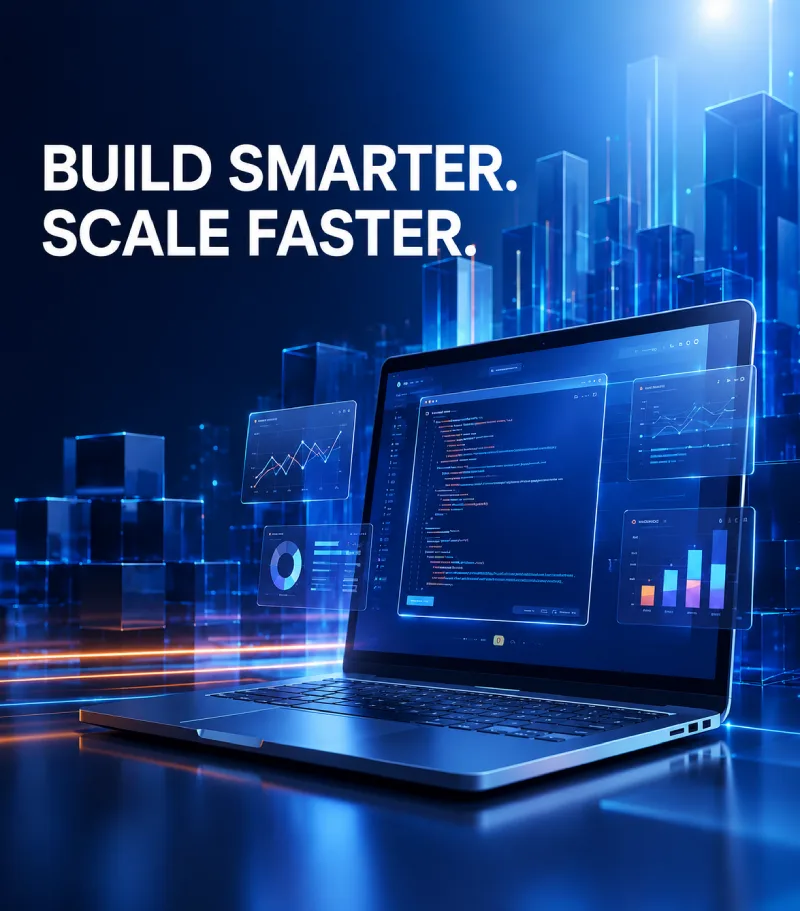
Platform engineering and FinOps discipline keep releases moving fast and the cloud bill explainable, tied to what’s actually driving cost, not a surprise at month’s end.

Manual data cleanup is disappearing into automation. What’s left, lineage, governance, and integration your team can actually audit, is where we put senior engineers.

Predictive monitoring catches most incidents before an alert fires. When one does reach a person, it’s already been triaged, not sitting in a queue.

Everything below is scoped to what your next milestone must prove, never a feature list.
A first release scoped to the assumption that kills the business if it's wrong, shipped in weeks and put in front of real users. Built on production bones, so if the MVP works, you extend it instead of rebuilding it.
Clickable prototypes and user flows tested before production code is written, because a week of design kills the features a quarter of engineering would have wasted. When a prototype is all your next conversation needs, we'll say so.
Multi-tenant architecture, billing and subscription logic, roles and permissions, and usage metering built in from the start, because retrofitting tenancy into a single-customer codebase is the most expensive rewrite in SaaS.
Component-based web interfaces and mobile apps that share one back end and one data model, so a feature ships to every surface once instead of being rebuilt per platform. See Custom Web Application Development for the deep build.
Right-sized infrastructure on AWS, Azure, or Google Cloud, deployed through infrastructure as code with cost monitoring from day one, so the bill grows with revenue rather than ahead of it. We help you claim the startup credits you're owed.
Documented, versioned REST or GraphQL APIs, plus the integrations early products live on: payments, auth, messaging, and the systems your first enterprise customer will demand you talk to.
Auditing an inherited codebase and giving you a written verdict: salvage, stabilize, or rebuild. The same audit prepares you for the technical due diligence an investor will run before wiring anything.

We audit your requirements, existing systems, and integration surface before committing to an architecture, the step most vendors skip on the way to a proposal.
Architecture, tech-stack selection, and team composition get signed off with your stakeholders before we write a line of production code.
Agile, product-centric delivery with CI/CD, automated test coverage, and code quality a production application needs, beyond what a prototype can carry.
Governance isn’t a status meeting. It’s executive steering, a live risk register, quality gates, and value tracking on every engagement.
Knowledge transfer, operational hyper care, and a plan for scaling the product past its first version, once it’s proven in production.
| Model | Best Fit When | What You Get | Buyer Proof Artifact |
|---|---|---|---|
|
RCV Outcome Delivery Pods |
A new AI feature or product needs to prove measurable value, not just ship |
KPI framing, a product pod, delivery analytics, value reviews, release telemetry |
Product KPI scorecard and release-health dashboard |
|
RCV Platform Accelerator |
An AI capability needs to be reusable across teams, not built once and abandoned |
Platform diagnostic, foundation sprint, golden paths, onboarding, adoption telemetry |
Platform catalog, adoption metrics, golden-path demo |
|
RCV Governance Assurance Model |
An AI program runs in a complex, regulated, or multi-vendor environment |
Governance handbook, cadence map, RAID log, quality gates, architecture controls, transition pack |
Real dashboard pack, escalation matrix, sample exit/transfer pack |
Problems at this scale usually aren’t about capability. They’re about capacity, ownership, and change control.
| A good fit if… | Probably not a fit if… |
|---|---|
|
You’ve validated a real problem and need it engineered into a product, not just prototyped |
You want the cheapest possible build for a pitch-deck screenshot; a clickable prototype is cheaper, and we’ll say so |
|
You want design, build, and deployment owned by one senior team
|
You expect a fixed price on undefined scope before any discovery has happened |
|
You want code and IP that survive investor due diligence and your first engineering hires
|
You just need extra developers on a team already running; see Hire Developers and IT Staff Augmentation |
|
You’re a non-technical founder who needs a technical partner that tells you the truth
|
You want the market validated for you; the build is rarely the riskiest part, and we’ll tell you when it isn’t |
We build web applications inside regulated, high-stakes environments.
Straight answers to what enterprise and fast-scaling buyers ask most.
A startup software development company makes decisions against your stage, not against an enterprise playbook. At pre-seed, the enemy is time: the build has to test your riskiest assumption before the runway does. At seed and beyond, the enemy is the rewrite: shortcuts taken in month one that cost you the quarter after your raise. A generic dev shop builds what the ticket says. We argue about what should be built at all, pick boring, hirable technology, and cut scope before we cut quality. The output is a product you can demo, sell, and hand to your first engineering hire.
Cost depends on scope: the number of workflows in the first release, how much integration is involved, whether design already exists, and how much of the data model is new. A single-workflow MVP is a small, contained build. A multi-tenant SaaS platform with billing, roles, and third-party integrations is a much larger one. Pricing scales with complexity, not a flat rate card. The fastest way to a real number is a scoping call where we review what you're building and why, or the cost calculator for a directional estimate before that call.
A scoped MVP typically ships in 6 to 12 weeks, with discovery and design taking 2 to 4 weeks before that. The variable isn't how fast we can type. It's how fast decisions get made: a founder who can approve a scope cut in a day keeps the schedule, and one who can't loses weeks. We ship a narrow, working version early and put it in front of real users, because that surfaces wrong assumptions while they're still cheap to fix. Your timeline is set against scope during Design & Capability Match, so you know the shape of the schedule before we start building.
Build the MVP unless you have hard evidence for the full product: paying customers on a manual version, signed commitments, or a regulated market where a partial product can't legally launch. An MVP exists to test the riskiest assumption for the least money, and most first assumptions turn out wrong in ways extra features would not have fixed. Where we differ from the cheapest MVP shops is what the MVP stands on: ours ships on an architecture that survives being right. If the MVP works, you extend it. You don't rebuild it.
You do, from the first commit. Source code, infrastructure configuration, design files, and documentation live in your repositories and your accounts, and IP assignment is written into the contract rather than implied. That matters twice: when an investor runs technical due diligence and asks who owns what, and when you hire your own engineers and they need a codebase they can read. We use standard tooling rather than proprietary frameworks, so the answer to whether someone else could maintain this is yes, and provably so.
Yes, and a large share of our startup engagements start exactly there. What changes is how we communicate, not what we build: decisions come to you as trade-offs in plain language with cost and time attached, rather than a stack debate you're expected to referee. You get a straight answer when a feature is expensive relative to what it proves, and a written record of what was decided and why, so your future CTO inherits reasoning instead of archaeology. What we won't do is use the knowledge gap to inflate scope.
That's the plan working, not a problem. The codebase is documented for a developer who wasn't in the room, the infrastructure sits in your accounts, and handover is a defined stage of the RCV Delivery Model rather than a favor. The transition can run gradually: your first hires ship alongside our engineers, we step back as they take ownership, and we stay available for escalation if you want it. Some founders also hire their first engineers through us; see Hire Developers. Either way, nothing in the engagement is built to make leaving expensive.
Yes, and it starts with an audit rather than a promise. We read the code, the infrastructure, and the commit history, then give you a written verdict on what's salvageable, what has to be rebuilt, and what it costs to keep versus replace. Sometimes the honest answer is that the codebase is fine and the previous team just documented nothing. Sometimes a rebuild is cheaper than a rescue. Either way, you get the verdict before you commit to the work, and the same audit doubles as preparation for investor technical due diligence.
Book a scoping call with an RCV World engineer, not a salesperson. Bring the problem, the deck if there is one, and whatever exists today: a napkin sketch, a Figma file, or a half-built repo. The call ends with a plain answer on whether a startup software development company is what you need right now, or whether a prototype, a hire, or waiting is the honest call.
RCV World helps businesses turn technology into measurable growth. We deliver AI, digital engineering, cloud, data, enterprise, managed, and talent solutions built around your goals. Our teams combine technical expertise, strategic thinking, and execution to create secure, scalable, and future-ready solutions for businesses across industries.
